
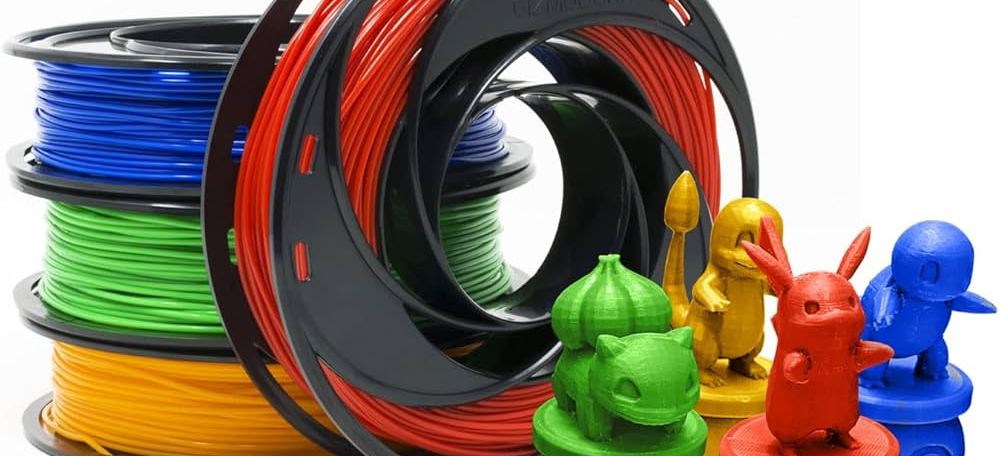

At Vidyasagar Academy we recently purchased a sophisticated 3D printer of Bambu A1 model. There is a cafeteria in Vidyasagar Academy and one of our faculty thought to make attractive 3D print containers for Salt, Pepper, etc. for the dining tables.
So he contacted me and told about this project. Being curious I researched on the feasibility of PLA material and searched that whether it is safe to use for storing eatables. When I started researching on it, I found may interesting but negative facts on it.
So to make all our students, faculty members and general public I am publishing this detailed post for you. Don’t skip it…! It’s very important post…!
Page Contents
show
Introduction
Plastic filament advertised as “PLA” is popular with hobbyists and makers because it is easy to print and biodegradable in the right settings.
However, there is an important difference between a polymer being chemically benign and a printed object being safe for repeated, direct contact with food and drink.
This post explains, in plain language, why PLA filament for 3D printing (and especially typical consumer PLA+ blends) is not a reliable choice for reusable water bottles, tiffin boxes, or other food-contact containers in a public setting like Vidyasagar Academy’s cafeteria.
What PLA actually is?
PLA stands for polylactic acid (often written poly(lactic acid) or poly(lactide)). It is an ester-based thermoplastic made from lactic acid (usually derived from plant starch). In principle, pure PLA resin can be formulated for food-contact uses.
But most consumer 3D printing filaments are not manufactured or certified as food-grade. They commonly contain pigments, performance additives, and processing aids that are not tested for food contact.
Why a 3D-printed bottle or tiffin is risky
1. Additives and colourants may leach
Commercial filaments frequently include dyes, plasticizers or strength modifiers. These additives are rarely disclosed in full on retail listings, and unless the filament is explicitly certified as food-grade by the manufacturer, you should assume it is not tested for migration into foods or liquids.
2. The FDM surface is porous and bacteria-friendly
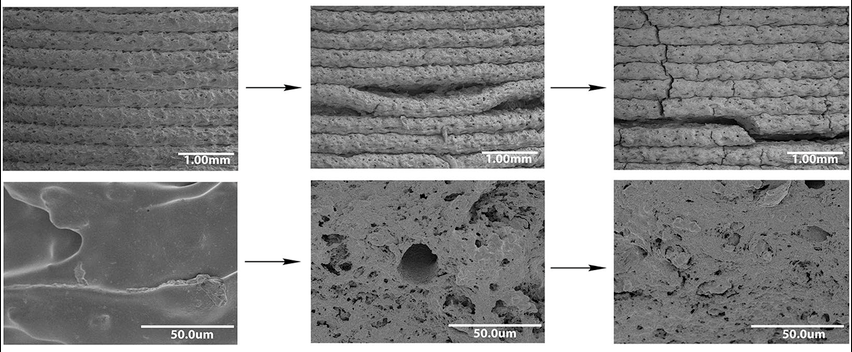
Fused Deposition Modeling (FDM) prints form by stacking many tiny layers. The resulting surface has microscopic gaps and layer lines that trap food particles, spices and moisture.
Research on bacterial biofilms on 3D-printed materials shows that microbes can colonize these crevices and are much harder to remove than from smooth, non‑porous surfaces.
3. 3D Printer hardware contamination
Standard brass nozzles and some printer components can introduce contaminants (brass alloys may contain trace lead). Food-safe printing workflows therefore recommend a dedicated stainless-steel nozzle and thoroughly cleaned extrusion paths for any parts intended for food contact.
4. Heat and cleaning limitations
PLA softens at relatively low temperatures (~55–65 °C). That means PLA bottles and lunch boxes are not dishwasher-safe and may deform with hot food or hot washing water, and elevated temperature can increase the risk of additive migration.
What the evidence and experts say?
Industry guides from reputable sources (Formlabs, Ultimaker, Xometry) caution that only filaments explicitly labelled and documented as food-grade should be considered for contact with food, and even then, special printing and post-processing steps are needed for safe use.
Scientific studies also demonstrate that sealing printed surfaces (for example with food-grade epoxy) markedly reduces bacterial colonization, and that unsealed FDM surfaces support biofilm growth more readily than smooth materials.
Practical recommendations
At Vidyasagar Academy we discarded the idea of 3D printing eatable containers because of the above given discussion and so we recommend the following for you –
Use glass or stainless-steel containers for all edible items. Glass and food‑grade stainless are inert, easy to clean and safe for daily cafeteria use.
Use 3D printing for decorative holders only. Print attractive outer shells, sleeves or nameplates in PLA and place certified glass/steel jars inside them. This keeps the design benefits of 3D printing while ensuring food safety.
If you must 3D-print food-contact parts: only use filaments with documented food-grade certification, print with a dedicated stainless nozzle and clean printer, and seal internal surfaces with an FDA‑approved food-safe coating. Even then, restrict use to dry, room‑temperature items and insist on hand-washing only.
Make this a teaching moment. Demonstrate the difference between aesthetic prototypes and certified food-ware — turn the design of decorative holders into a student CAD + printing project.
Photos of a layered FDM surface under magnification showing crevices
References & further reading
- Formlabs: Guide to food-safe 3D printing (practical recommendations and coatings).
- Ultimaker: Is PLA food safe? (guide on additives and food-grade formulations).
- PubMed/PMC: “Bacterial Biofilm Growth on 3D-Printed Materials” (research showing biofilm formation on printed surfaces).
- ResearchGate: Study on sanitization efficacy for safe use of 3D-printed parts (cleaning and sterilization tests).
- Xometry / JLC3DP: Practical articles discussing hardware and nozzle recommendations.







polylactic acid for any type of edible items.